

If you own or manage a home service business, you’ve probably asked yourself a tricky question: Which of my leads are worth pursuing?
Every day, people see your ads or your website. Some call, some click, some ask a neighbor for a referral. But not everyone who shows interest is ready or able to become a paying customer. Businesses must determine which leads are most valuable, which ones just need more time, and which aren’t likely to buy at all.
Understanding the difference between different leads can save you time, money, and frustration. Even better, it can help you build a sales process that turns more of those potential leads into actual customers.
DW Creative helps home service businesses grow by building strong connections between their brands and the homeowners they serve.
By reading this article, you will learn about the different kinds of sales leads and how to nurture them into customers.
What Is a Sales Lead?
At its core, a sales lead is someone who:
- Has a problem or pain point that needs solving soon
- Has the resources to solve it (time, money, authority)
- Sees your business as a potential solution
A true sales lead is not someone scrolling through your website or watching one of your commercials out of curiosity. A true sales lead is someone closer to making a buying decision.
However, some individuals express interest but are not yet ready to make a purchase. These are known as marketing-qualified leads (MQLs). With proper follow-up, education, and reminders, many MQLs can eventually develop into strong sales leads.
Kinds of Sales Leads for Home Service Businesses
Not all leads come from the same place.
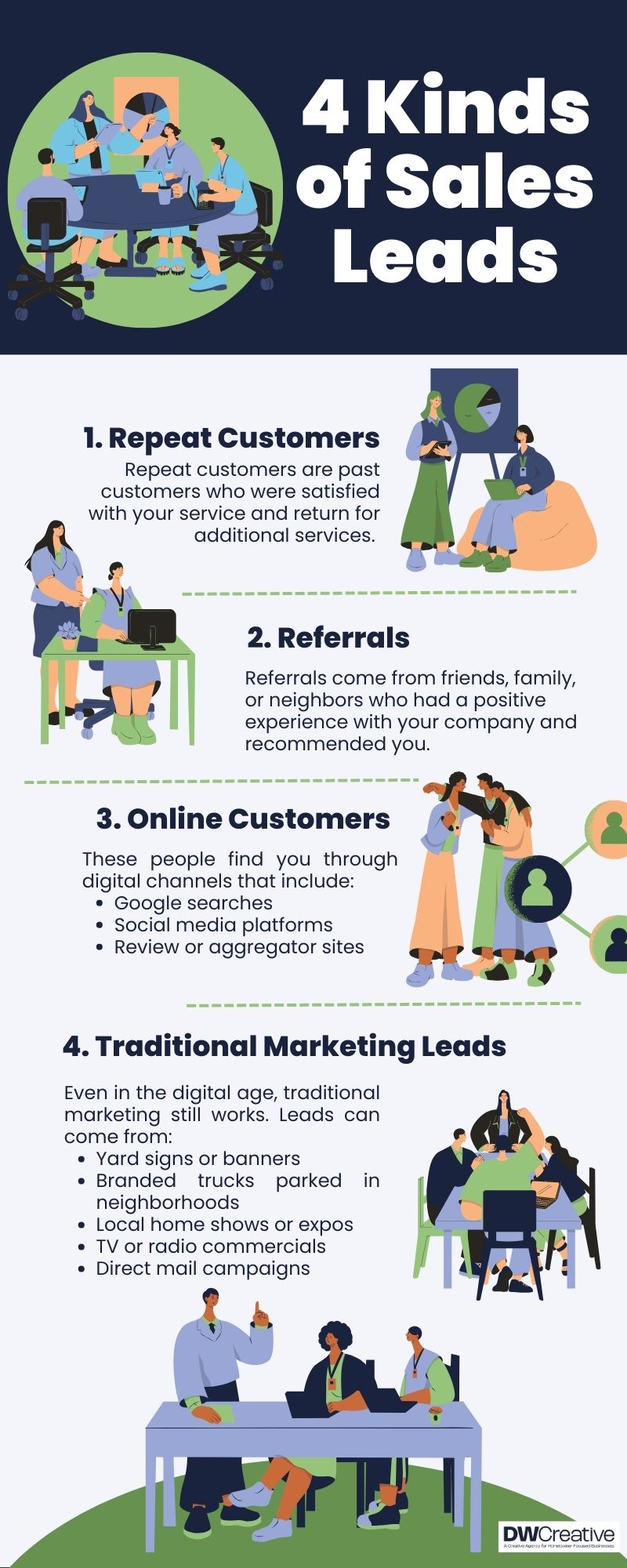
Here are the most common types of sales leads you’ll encounter in home services:
1. Repeat Customers
Repeat customers are past customers who were satisfied with your service and return for additional services. They often have the highest conversion rate since they already trust your brand.
2. Referrals
Word of mouth still matters. Referrals come from friends, family, or neighbors who had a positive experience with your company and recommended you. While these leads are strong, they aren’t always guaranteed sales.
3. Online Customers
These people find you through digital channels that include:
- Google searches (SEO or paid ads).
- Social media platforms like Facebook, Instagram, or TikTok.
- Review or aggregator sites such as Angie’s List or HomeAdvisor, where they are presented with several providers to choose from.
4. Traditional Marketing Leads
Even in the digital age, traditional marketing still works. Leads can come from:
- Yard signs or banners
- Branded trucks parked in neighborhoods
- Local home shows or expos
- TV or radio commercials
- Direct mail campaigns
How Do You Determine Which Leads Are More Valuable?
There’s a common belief in sales that referrals are always the best leads. While referrals are strong, research and experience show that repeat customers often convert at even higher rates because they’ve already experienced your work.
The key is not to assume any single type of lead is automatically better. Instead, you need to analyze:
- Likelihood to buy again (repeat customers tend to be highest)
- Trust factor (referrals carry borrowed trust, which is strong but not foolproof)
- Buying stage (is the person ready to commit now, or just browsing?)
Does Marketing Affect Referrals?
Some business owners believe that referrals happen regardless of their efforts. But think about it: even if a friend referred someone, what else might have influenced them before they called you?
- Did they see your truck parked on a job site?
- Did they scroll past one of your Facebook posts?
- Did they glance at your ad in the local paper?
Marketing reinforces the referral by making your business familiar and trustworthy. It often works behind the scenes in ways that are easy to overlook.
Tracking and Scoring Leads
One of the most effective ways to measure lead value is through a process called lead scoring. Lead scoring assigns points to potential leads based on behaviors that, in the past, led to sales. You can lead score based on a potential customer’s interaction with your marketing campaigns and website. Essentially, lead scoring asks, “How did they find me? How ready are they to buy?”
Businesses often use a Customer Relationship Management (CRM) system to track and evaluate customer behavior.
Here are a few behaviors worth tracking:
- Which pages on your website they visit (service pages vs. homepage)
- If they fill out forms or request quotes
- If they download guides or resources
- If they attend webinars, events, or consultations
By identifying patterns, you can determine which actions typically lead to sales. For example:
- “Most of our customers looked at our financing page before booking.”
- “Almost everyone who bought visited our testimonials page.”
Reverse-engineering past customer activity helps you create a blueprint for identifying your strongest future leads.
Sales Leads vs. Marketing-Qualified Leads
It’s essential to recognize the difference:
- Marketing-Qualified Lead (MQL): Interested, but not ready to buy. They may need more education, more proof, or simply more time.
- Sales Lead: Ready to talk seriously about hiring you or buying your service.
The goal is to nurture MQLs until they’re ready. Nurturing MQLs might mean:
- Sending helpful follow-up emails with tips or reminders
- Providing educational blog posts, videos, or FAQs
- Retargeting with ads so your brand stays top-of-mind
- Offering easy next steps, like free estimates or consultations
Once someone engages heavily by visiting multiple pages, downloading a guide, or filling out a contact form, they may be ready for a sales call.
What to Track to Find Qualified Leads
The best way to understand lead behavior is to study your customers. Look at your last 20–30 sales and ask:
- Which pages did they visit on our site?
- How many times did they interact with our brand before making a purchase?
- Did they engage with specific ads, emails, or social media posts?
This type of analysis highlights the touchpoints that influence sales. Over time, you’ll know what actions predict a high-value lead.
How Marketing Agencies Help
If this sounds overwhelming, you don’t have to do it alone. Many marketing agencies specialize in helping home service businesses identify and nurture leads. They can:
- Define your ideal buyer profile.
- Research where and when your buyers are likely to consume media (and, therefore, see your ads).
- Strategize the best times, platforms, and messages to reach them.
- Track and score leads more efficiently.
By combining your expertise with a marketing agency’s data, you can better focus your efforts on the leads most likely to convert.
Next Steps for Identifying Sales Leads
Not all leads are created equal.
Some are ready to buy right now.
Others need more time and nurturing before they make a decision.
By understanding the difference between sales leads and marketing-qualified leads, tracking buyer behavior, and studying past customer patterns, you can determine the value of a potential lead. Once you have that, you focus your time and resources on the opportunities with the highest value.
To evaluate your sales process, you might:
- Review your last 20–30 customers and identify patterns in their behavior.
- Start using a CRM or another system to track lead activities.
- Create materials (guides, blog posts, emails) to nurture MQLs until they’re ready to make a purchase.
When you know which leads to prioritize, you’ll spend less time chasing dead ends and more time closing deals.
DW Creative is an agency committed to empowering homeowner-focused businesses. If you want help creating a marketing strategy or brand designs, schedule a fit call with our team to see how DW Creative can help.
If you’re not ready to make a commitment or want to learn more about marketing strategy and digital marketing, we recommend the following articles:
- What It Takes to Create an Effective Marketing Campaign
- Why Skipping Marketing Can Cost You More Than Investing in It
- 5 Common Home Contractor Marketing Mistakes
Originally posted for DW Creative.
 SJ Bocci Writes